**Update (June 29, 2026):** CAPE Phase 2 opened on schedule today — reconciliation and AD/CVD entries are now accepted in the ACE Portal. The guide below has been updated to reflect the live status. The headline for importers chasing IEEPA tariff refunds: CBP's CAPE Phase 2 opened June 29, 2026, expanding the refund tool beyond the clean, automatable entries of Phase 1 to include reconciliation entries and antidumping/countervailing duty (AD/CVD) entries. A third phase — for finally-liquidated entries, available only to importers who filed at the Court of International Trade — is expected in late July 2026. This guide breaks down what each phase covers, how much of the ~$166 billion IEEPA pool has actually been refunded so far, and whether the 10% Section 122 tariff is still being collected while its own court fight plays out. (Updated June 29, 2026 — a fast-moving situation; figures reflect the latest available CBP data.)
What Does CAPE Phase 2 Cover? (Live as of June 29, 2026)
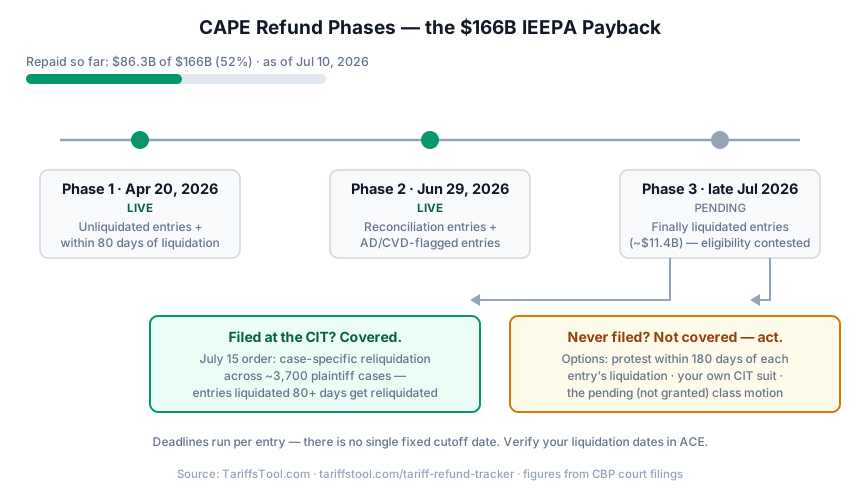
CAPE Phase 2 opened June 29, 2026 and is now live in the ACE Portal. Phase 1, live since April 20, 2026, was deliberately narrow — it processed the cleanest, most automatable IEEPA entries: unliquidated entries and entries within 80 days of liquidation. Phase 2 widens the funnel to two categories Phase 1 could not handle:
- Reconciliation entries — entries flagged for post-summary reconciliation, where final values were not fixed at the time of entry.
- Antidumping and countervailing duty (AD/CVD) entries — entries that also carry AD/CVD, which require extra handling.
If your IEEPA-period entries were excluded from Phase 1 for either reason, Phase 2 is your channel. The mechanics are the same: file a CAPE Declaration through the ACE Secure Data Portal, with refunds issued by ACH.
What Is the Difference Between CAPE Phase 1, 2, and 3?
CBP is rolling out CAPE refunds in three phases, each covering a harder-to-process slice of the roughly 53 million IEEPA entries:
- Phase 1 (live April 20, 2026): unliquidated entries and entries within 80 days of liquidation — the cleanest cases, processed first.
- Phase 2 (opened June 29, 2026 — now live): reconciliation entries and AD/CVD entries — an estimated 2.8 million additional entries worth roughly $28.7 billion, lifting combined Phase 1 + Phase 2 coverage to about $130 billion of the $166 billion pool.
- Phase 3 (expected late July 2026): finally-liquidated entries — but available only to importers who filed a protective action at the Court of International Trade.
The Phase 3 limitation matters: if your entries have already finally liquidated and you did NOT file at the CIT, your path to a refund is narrower. That is the single biggest reason trade attorneys urged importers to preserve their rights early.
Advertisement
How Much Has Actually Been Refunded So Far?
It helps to separate the pool from the payments. About $166 billion in IEEPA duties were collected across roughly 330,000 importers and 53 million entries — that is the full refundable pool. But as of mid-June 2026:
- CAPE had queued over $95 billion for refund through Phase 1, and
- approximately $23.7 billion had been approved and transmitted to the US Treasury as of mid-June 2026.
In other words, the money is flowing, but most of the pool is still in the queue — which is exactly why the Phase 2 and Phase 3 expansions matter. Refunds include statutory interest, and only the IEEPA layer is refundable — Section 232 and Section 301 duties are not.
Is the 10% Section 122 Tariff Still Being Collected?
Update: No — it expired on schedule. The 10% Section 122 global tariff that replaced the struck-down IEEPA tariffs survived one court loss:
- On May 7, 2026, the Court of International Trade ruled the Section 122 tariff unlawful.
- On June 11, 2026, the Federal Circuit granted a stay pending appeal, so CBP kept collecting the 10% while that appeal proceeded.
But the stay only kept the tariff alive against that court ruling — it didn't override Section 122's own 150-day statutory limit, which ran out at 12:01 a.m. ET July 24, 2026. Congress never extended it, so the tariff lapsed by operation of law that morning. USTR's planned replacement — a two-tier 10%/12.5% Section 301 tariff on roughly 60 economies, tied to forced-labor import protections — took effect the same moment, so there was no gap in collection for most importers. One technical note that still applies: neither the old Section 122 nor the current Section 301 replacement stacks on the metal content of Section 232 steel, aluminum, or copper articles.
Could the Government's Appeal Stop My Refund?
This is the live risk. The government filed notices of appeal on June 2-3, 2026, challenging the CIT's orders that required universal IEEPA refunds — that is, refunds to all importers, not just those who sued. The government's argument leans on Trump v. CASA, the 2025 Supreme Court decision curbing nationwide injunctions, to contend the CIT cannot order relief for importers who never filed.
On June 9, 2026, the CIT held a hearing on whether to lift its own stay of the refund orders; it ended without lifting the stay, but surfaced useful detail on CAPE's scope. The practical takeaway: CAPE keeps running and paying in the meantime, but the universal scope of the refunds is contested on appeal. File promptly and keep your records — a faster, cleaner filing is better protected than a slow one.
What Should Importers Do Now That Phase 2 Is Live?
- Confirm ACE Portal access and ACH enrollment. No ACH, no refund — and enrollment is the most common bottleneck.
- Pull your entry data now. Gather Form 7501 entry summaries for your IEEPA-period entries (China, Canada, and Mexico fentanyl entries from February 4 / March 4, 2025; reciprocal entries from April 2025) through February 24, 2026.
- Sort entries by phase. Clean unliquidated entries go through Phase 1 (live since April 20, 2026); reconciliation and AD/CVD entries are now eligible for Phase 2 (live as of June 29, 2026); finally-liquidated entries may need a CIT filing for Phase 3 (expected late July 2026).
- Estimate before you file. Know your refundable number — the IEEPA layer only — so you can validate CBP's math.
- File promptly. With the government appealing the universal refund order, early, clean filings are the best protected.
A Second Refund on the Same Entries
Already claiming your IEEPA refund?
If you re-export any of your imports, you may also be owed duty drawback — 99% of duties back, retroactive 5 years. Same entry data, second check.
See How Drawback Works →Key Takeaway
CAPE Phase 2 opened June 29, 2026 and is now live — it opens the door for reconciliation and AD/CVD entries that Phase 1 left out, with Phase 3 for finally-liquidated entries expected in late July. Meanwhile the 10% Section 122 tariff keeps being collected under a Federal Circuit stay (and is set to expire around July 24 under its 150-day statutory limit), and the government is appealing the scope of the refunds. The importers who come out ahead are the ones who file clean Phase 2 Declarations promptly — early filings are better protected while the appeal plays out. Estimate your refund, sort your entries by phase, and file clean.
Refunds this size require careful CAPE filing
CBP rejects CAPE filings for entry-mix errors, wrong tariff authority coding, bad ACH enrollment, and incorrect CSV formatting. Our network of licensed customs brokers and trade attorneys handles the entire filing — so you don't leave money on the table or get stuck behind a rejection.
Get a Free Filing Consultation →No obligation. Licensed professionals only. Typical first-call within 1 business day.
Advertisement