
Update, Sept 15: CBP told the Court of International Trade in a new declaration that Phase 3 will deploy October 6, 2026. Access is limited to importers who are plaintiffs in a pending CIT case seeking IEEPA refunds and who submitted their IOR number to CBP by July 30, 2026 — importers who haven't sued still have no administrative path to a refund on finally liquidated entries. Phase 1 and 2 processing continue unaffected. Separately, DOJ's Federal Circuit appeal of the CIT's reliquidation order (opening brief filed Aug 10) remains pending — that appeal, not the October 6 launch, decides whether non-litigant importers can be paid administratively at all. If you have finally liquidated entries and an open 180-day protest window, don't wait on Phase 3 to act. Get help with a finally liquidated claim →
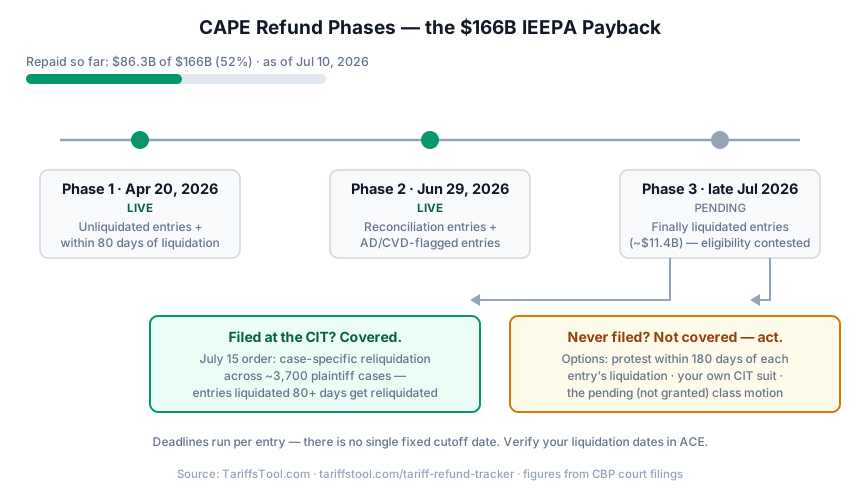
CAPE Phases 1 and 2 had a simple story: file a clean declaration, get paid. Phase 3 — originally on track for **late July 2026**, delayed by CBP on August 25 to add validations, and now confirmed by CBP to deploy **October 6, 2026** — is different. It covers the roughly **$11.4 billion in IEEPA duties sitting on finally liquidated entries**, and for the first time, having eligible entries may not be enough. The government has appealed the CIT's universal-refund orders to the Federal Circuit and takes the position that CBP lacks authority to reopen finally liquidated entries unless the importer filed an individual lawsuit. Under that reading, **Phase 3 pays only importers who filed a protective action at the Court of International Trade** — and specifically, only those who submitted their IOR number to CBP by July 30, 2026 — everyone else waits on the appeal, a newly filed class-action certification motion, or their own protest or lawsuit. If any of your 2025 IEEPA entries have finally liquidated, protecting your own protest window remains critical even with a launch date confirmed. Here's the full picture and a decision framework. For the current dollar totals and phase status, see our [CAPE refund status tracker](/cape-refund-status).
What Phase 3 Covers — and Why These Entries Are Different
A customs entry liquidates when CBP finalizes the duties on it; liquidation becomes final once the window to reopen it administratively has passed. Phases 1 and 2 deliberately covered only unliquidated entries and entries within 80 days of liquidation — the ones CBP can still adjust on its own authority. Phase 3 is everything else: entries that liquidated with IEEPA duties baked in and aged past the window, roughly $11.4 billion across the 2025 tariff period.
If you imported heavily in early-to-mid 2025 and didn't act quickly after the February ruling, there's a good chance a meaningful share of your refund pool sits here. These are disproportionately the entries of smaller importers — the companies without customs counsel watching liquidation dates — which is exactly why this phase is where the fight is.
The Catch: The Government Says Only CIT Filers Get Paid
CBP will have the technical capability to process finally liquidated refunds starting October 6, 2026. Whether it will use that capability for everyone is the contested question.
The Department of Justice's position: finality is finality. Once an entry finally liquidates, CBP lacks statutory authority to reliquidate it unilaterally — the importer's remedy was a protest or lawsuit, and importers who did neither are out. On that reading, Phase 3 processes refunds only for importers who filed a protective action at the Court of International Trade before their entries' finality locked in.
The CIT disagreed: Judge Eaton's orders require universal refunds of the unlawful duties, finally liquidated or not. The government has appealed those orders to the Federal Circuit, and until that appeal resolves, importers without a CIT case are in limbo — collectively owed tens of billions of dollars they may need litigation to recover.
Update, July 15: the CIT moved from principle to mechanics. The court signaled it will issue case-specific orders across roughly 3,700 individual IEEPA cases, each directing CBP to reliquidate — without IEEPA duties — the entries of plaintiffs in that case that liquidated more than 80 days ago. That's the plaintiffs-only reading in concrete form: if you're one of the roughly 3,700 named cases, your finally liquidated entries now have a specific court-ordered path to reliquidation. If you're not, this order does nothing for you directly — it's one more reason not to wait on the Federal Circuit appeal or the class motion if you have material exposure and an open protest window.
Advertisement
The Class Action That Could Change the Math
The newest development: a motion for class certification has been filed at the CIT seeking to certify a class of importers who are currently ineligible under CBP's systems — principally those holding finally liquidated entries with no individual lawsuit on file.
If certified, the class would sweep in exactly the importers the government's position excludes, without each one having to file its own case. It is a genuine potential backstop — but it is a motion, not a ruling. Certification is not guaranteed, the government will oppose it, and class relief could take substantially longer than Phase 3 payments to CIT filers. Treat it as a safety net you might land in, not a strategy you choose. If you have material exposure and an open protest window, acting on your own timeline still dominates waiting on someone else's motion.
Do You Need to Sue? A Decision Framework
Work through these in order:
- You already filed at the CIT. You're in the strongest position — you're in the group even the government concedes gets paid. Watch for the Phase 3 opening and be ready to file your declaration immediately.
- Your entries are NOT finally liquidated (unliquidated or within 80 days). You don't need Phase 3 at all — file through Phase 1/2 now, before they age out. Every week of waiting moves entries toward the contested pool.
- Finally liquidated, no lawsuit, protest window still open. File a protest under 19 U.S.C. § 1514 within 180 days of liquidation. A timely protest preserves your claim regardless of how the Federal Circuit appeal or the class motion resolves. This is the single most time-sensitive move on the board — entries that liquidated in the first quarter of 2026 have windows closing this summer.
- Finally liquidated, protest window closed, six-figure-plus exposure. Talk to trade counsel about filing at the CIT now. An individual suit is the one path the government concedes, and for exposure over ~$500K the economics usually work.
- Finally liquidated, window closed, smaller exposure. Your realistic paths are the Federal Circuit affirming universal refunds or the class action being certified. Document everything now — entry numbers, liquidation dates, IEEPA duty amounts — so you can move the day either door opens.
The Deadline Nobody Is Watching: 180-Day Protest Windows
The protest deadline runs 180 days from the date of liquidation — entry by entry, not importer by importer. That means there is no single cliff date; every week, another tranche of 2025-period entries quietly passes from 'protestable' to 'final,' shifting those dollars from the safe column to the contested one.
Run the exercise this week: pull your liquidation dates from ACE (report ES-003 shows entry status), flag every IEEPA entry that has liquidated, and compute each one's 180-day mark. Entries still inside the window can be preserved with a protest for a filing cost that is trivial next to the duties at stake. Entries past it are betting on the courts. The difference between those two outcomes, for many importers, is simply whether anyone looked at the dates in July.
What to Do This Week
- Pull liquidation status on every IEEPA-period entry (ACE report ES-003). Sort into: unliquidated / within 80 days / finally liquidated.
- File Phase 1/2 declarations immediately for anything not yet final — don't let clean entries age into the contested pool.
- Calculate 180-day protest deadlines for every liquidated entry and calendar them.
- File protests on in-window entries with material IEEPA duties — it's the cheapest insurance available.
- If you filed at the CIT, prepare your Phase 3 declaration package now so you're in the first batch when it opens.
- If you're stuck in the excluded group, document your entries and get a professional read on your exposure — the class action and the appeal will move fast once decided, and the importers who recover will be the ones with their paperwork ready.
Key Takeaway
Phase 3 is where the IEEPA refund story stops being an administrative process and becomes a legal one. The capability arrives October 6, 2026; the eligibility fight — the government's Federal Circuit appeal versus the CIT's universal-refund orders and a pending class-action motion — decides who it actually pays. Your job this week is simpler than the litigation: know which of your entries are finally liquidated, protest everything still inside its 180-day window, and file Phase 1/2 declarations on anything not yet final before it ages out. If you're holding six figures of finally liquidated IEEPA duties with no protective action on file, get help now — that's the exact profile of importer the current rules leave behind. For current dollar totals, see the [CAPE refund status tracker](/cape-refund-status); for the filing workflow, [how to claim an IEEPA refund](/guides/ieepa-tariff-refund-how-to-claim-2026).
Calculate Your Import Duty
Get an instant estimate for your specific product, country, and shipment value.
Open the US Import Duty CalculatorAdvertisement