
The 5-Year Lookback: Every Entry Back to Mid-2021 Is Still Claimable
Start with the part most importers find hardest to believe: duty drawback is retroactive for five years. Not five years from when you learned the program existed. Five years from each import entry, rolling forward continuously. Today, in June 2026, that window reaches back to mid-2021 — before the IEEPA tariffs, before Section 122, before most of the current tariff regime existed.
Think about what sits inside that window. 2021 through 2026 covers the highest-duty period in modern American trade history: Section 301 lists at 7.5% to 100% on Chinese goods, Section 232 steel and aluminum at 25% climbing to 50%, and base MFN rates on top. If you imported and re-exported through any part of that period, you paid duties that the law says you can take back — at 99 cents on the dollar.
The catch is the clock. A container entered in July 2021 becomes unclaimable in July 2026. Every month you wait, another month of 2021-2022 entries — your highest-tariff years if you imported from China — expires permanently. The first claim an importer files is almost always the largest of their life, because it sweeps up to five years of accumulated recovery in a single filing. After that, drawback becomes an annuity: a recurring annual refund for as long as you import and export.
“The IEEPA refund was a one-time event. Drawback is the same money, every year, forever — and the first check reaches back to 2021.”
What Duty Drawback Is — 19 U.S.C. § 1313 in Plain English
Duty drawback is one of the oldest programs in the US federal government — it was written into the second act of the first Congress in 1789, signed by George Washington. The logic hasn’t changed in 237 years: import duties exist to protect the domestic market. If your goods never stay in the domestic market — because you re-export them, destroy them, or build them into products you ship overseas — the duty served no purpose, and the Treasury gives it back.
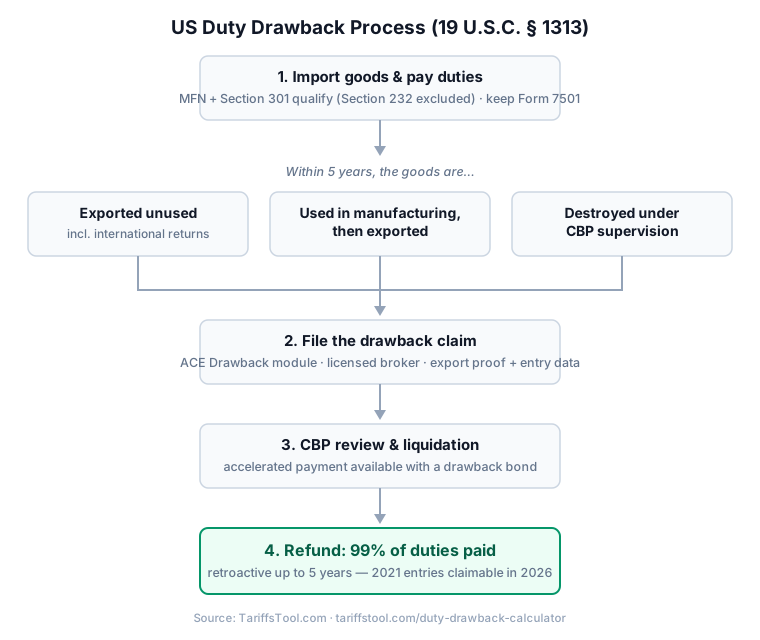
The modern statute, 19 U.S.C. § 1313, says it directly: when imported merchandise is exported or destroyed under CBP supervision within five years, 99% of the duties, taxes, and fees paid on that merchandise shall be refunded as drawback. The 1% holdback covers CBP’s administrative cost. Everything else comes back to you.
This is not a loophole, a gray area, or an aggressive position. It is a standing statutory entitlement with its own CBP processing module, its own claim form, and its own dedicated specialists inside the agency. The only unusual thing about drawback is how few of the importers entitled to it ever file.
The 3 Types of Drawback — With Real Numbers
Nearly every drawback claim falls into one of three statutory categories. Most importers qualify under at least one without changing anything about how they operate.
1. Unused Merchandise Drawback — § 1313(j)
You import goods, they sit in your warehouse, and you export them — unused — to a customer in Canada, Europe, or anywhere else. Example: a distributor imports $2,000,000 of power tools from Taiwan at a 6.5% duty rate ($130,000 in duty) and ships 40% of the inventory to Canadian and Mexican retailers. Drawback recovery: $130,000 × 40% × 99% = $51,480 — for that year alone.
2. Manufacturing Drawback — § 1313(a)/(b)
You import components, build them into a finished product in the US, and export the finished product. The duty on the imported component content comes back. Example: an equipment maker imports $3,500,000 of motors and electronics at an average 5% duty ($175,000) and exports 55% of finished units. Recovery: $175,000 × 55% × 99% = $95,288 per year.
3. Rejected Merchandise Drawback — § 1313(c)
Goods arrive defective, non-conforming, or shipped without consent — and you return them to the supplier or destroy them under CBP supervision. Example: an apparel importer receives $800,000 of garments at 12% duty ($96,000), rejects 15% for quality failures and re-exports them to the factory. Recovery: $96,000 × 15% × 99% = $14,256 — on goods that were a write-off anyway.
TFTEA: The 2018 Rules That Made Drawback Actually Workable
If you looked at drawback a decade ago and walked away, look again. The Trade Facilitation and Trade Enforcement Act (TFTEA), fully effective February 2018, rebuilt the program around three changes that matter:
- Substitution at the 8-digit HTS level. The old law required tracing the exact imported widget to the exact exported widget — lot by lot, serial by serial. TFTEA lets you match any import to any export sharing the same 8-digit HTS code. Import 10,000 motors in March, export 4,000 similar motors in November: they match. This single change converted drawback from a forensic accounting project into a data exercise.
- Electronic filing through ACE. Claims file digitally through the same ACE system that processed your original entries (and your CAPE refund, if you filed one). The import data needed for a claim already exists in ACE — it’s the same Form 7501 data your broker transmitted at entry.
- A uniform 5-year window. TFTEA standardized the claim deadline at five years from import entry for all drawback types — replacing a patchwork of 3-and-5-year rules that tripped up filers under the old regime.
The practical consequence: a program that used to require specialist consultants for even modest claims now runs on entry data you already have, matched by rules a competent filer can apply at scale.
Halfway Point
The rules favor you. The math probably does too.
If any share of your imports leaves the country — re-exported, built into exported products, returned to suppliers, or destroyed — run the 60-second estimate. The 5-year catch-up number surprises almost everyone.
Run My 60-Second Estimate →Free · 60 seconds · No commitment
What's Your Number? — Free Drawback Estimate
Imports × duty rate × export share × 99% × up to 5 years.
How much do you import per year?
Total declared value across all entries. A rough range is fine.
Who Qualifies — Including the Path Almost Nobody Knows About
The obvious qualifiers first. You likely have a drawback claim if you are:
- An importer-distributor who re-exports — any goods shipped onward to Canada, Mexico, Latin America, Europe, or Asia after entering the US.
- A manufacturer using imported inputs — components, raw materials, or sub-assemblies that end up inside products you export.
- An e-commerce or retail operation with overseas returns — customer returns and unsold inventory shipped back to foreign suppliers or liquidated abroad.
- Anyone who destroys imported inventory — expired, damaged, or obsolete goods destroyed under CBP supervision qualify the same as exports.
Now the lesser-known path: you don’t have to be the exporter. Drawback rights attach to the goods and can be transferred between parties. If you import merchandise and sell it to a US customer who exports it, the law gives the drawback right to the exporter by default — but that right can be assigned back to you by agreement, or the exporter can file with your import data and share the recovery. Importers sitting one step back from the border routinely assume they’re ineligible. They’re usually wrong — it just takes a piece of paper and a counterparty who’d also like a check.
The Math: What Recovery Actually Looks Like
Drawback math is four numbers multiplied together. Annual import value, average duty rate, the share of goods that leaves the country, and the statutory 99% recovery rate.
Worked Example — Mid-Size Importer
- Annual imports: $5,000,000
- Average duty rate: 8% → $400,000 duty paid/yr
- Share re-exported: 30% → $120,000 eligible
- Statutory recovery: 99%
Annual recovery: $118,800 / year
5-year retroactive catch-up: up to $594,000 on the first claim
Two things make this number different from almost any other recovery program. First, it repeats: the same importer collects roughly $118,800 again next year, and the year after, for as long as the import-export pattern holds. Second, the first claim reaches backward: up to five years of accumulated recovery, claimable now, shrinking month by month as 2021 entries expire.
Why Most Importers Never Claim
Industry estimates have been consistent for years: most of the drawback importers are entitled to is never claimed. Billions in statutory refunds, forfeited annually. The reasons are mundane:
- “My broker would have told me.” Customs brokers are paid per entry to clear goods inbound. Drawback is a separate specialty with separate licensing economics — most brokers don’t file it, so most never bring it up. Silence isn’t a sign you don’t qualify; it’s a sign nobody was paid to check.
- The recordkeeping myth. The program’s pre-2018 reputation — lot-level tracing, serial-number matching — still scares off importers who’ve never heard of TFTEA substitution. Under current rules, the documentation is your existing entry data plus export records you already keep for other reasons.
- Nobody owns it internally. Drawback sits between logistics, finance, and compliance. Each department assumes another would handle it. A refund that belongs to everyone is claimed by no one.
- It feels too good to be true. A 99% refund, five years back, recurring forever, from a federal statute signed in 1789 — importers hear the pitch and assume there’s a catch. The catch is the paperwork, and the paperwork got fixed in 2018.
How Drawback Stacks With Your IEEPA Refund — A Second Check on the Same Entries
If you filed (or are filing) a CAPE Declaration for the IEEPA refund, you have already done most of the data work a drawback claim requires — and you may be owed a second check on the very same entries.
The two programs refund different duties and don’t conflict. The IEEPA refund returns the unlawful IEEPA reciprocal tariffs collected April 2025 – February 2026 — struck down by the Supreme Court, repaid through CAPE. Drawback refunds the duties that were lawful all along — MFN base rates, Section 301, Section 232 — on the share of your imports that was exported or destroyed. An entry from Vietnam in mid-2025 might generate an IEEPA refund on its 46% reciprocal tariff and a drawback recovery on its base-rate duty if the goods were re-exported.
Practically, the overlap is the opportunity: the entry-level data you reconciled for CAPE — entry numbers, HTS codes, values, duties paid — is the exact input a drawback claim starts from. Importers who finished a CAPE filing are sitting on a pre-built drawback file and mostly don’t know it. See our full guide on stacking drawback with IEEPA refunds.
Process and Timeline: From First Look to First Check
- 1. Eligibility screen (week 1). Match your import profile (entry data, duty paid by HTS code) against your export, destruction, and return activity. This is where the recovery estimate gets real numbers behind it.
- 2. Claim preparation (weeks 2-6). Build the claim on CBP Form 7551: match imports to exports under TFTEA substitution rules at the 8-digit HTS level, compute the 99% recovery per entry, and assemble supporting export documentation.
- 3. Electronic filing through ACE (week 6+). Claims transmit through the ACE Drawback module — the same system that holds your original entry data.
- 4. Accelerated payment (weeks to ~3 months). With accelerated payment privilege — a one-time application supported by a drawback bond — CBP pays accepted claims within weeks, before final liquidation. Without it, expect 6-12 months for clean claims.
- 5. Repeat annually. Once the first claim establishes your program — privilege applications approved, matching methodology accepted — subsequent annual claims are largely mechanical.
The first claim carries the setup work and the five-year jackpot. Every claim after it is maintenance on an annuity.
Go Deeper
- Duty drawback process flow chart →
- The 5-Year Lookback: Claiming Duties Back to 2021 →
- Drawback + IEEPA: Two Refunds on the Same Entries →
- Unused Merchandise Drawback, Explained →
- Manufacturing Drawback, Explained →
- Drawback for E-Commerce Returns and Exports →
- Duty Drawback Calculator: Estimate Your Refund →
- Duty Drawback Filing Services: Who Files Your Claim →
- IEEPA Tariff Refunds Hub →
The Window Is Shrinking
2021 entries expire month by month. Find your number today.
The 60-second estimate tells you the annual recovery and the 5-year retroactive catch-up. If the number is real, Master Plan's team walks you through the claim on contingency — you pay only on recovery.
Get My Free Drawback Estimate →Free · 60 seconds · No commitment