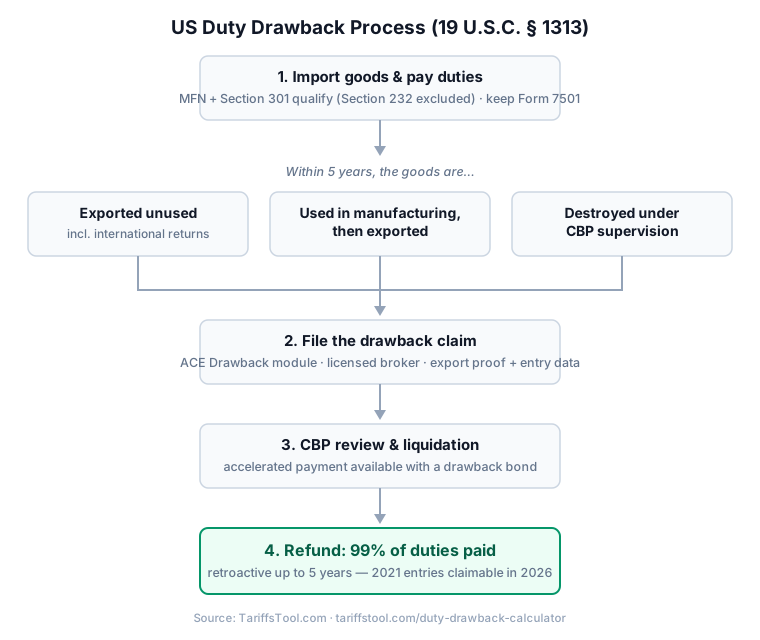
Duty drawback is the original US duty refund program. Codified in 19 U.S.C. § 1313, it predates the IEEPA refund saga by roughly a century. The mechanism: if you import goods, pay duty on them, and then either export the goods, destroy them under CBP supervision, or use them in manufactured products that are exported, you can recover up to 99% of duties paid. Drawback is filed through the ACE Drawback module by licensed customs brokers and can apply to entries up to five years old. Here's how it works, who qualifies, and how it differs from the CAPE IEEPA refund.
What Duty Drawback Actually Is
Drawback is a refund of US Customs duties, taxes, and certain fees paid on imported merchandise, granted when the merchandise is subsequently exported or destroyed. It's authorized under 19 U.S.C. § 1313.
The statute allows up to 99% recovery — the 1% retention covers CBP administrative costs.
Drawback is not new. It dates back to the Tariff Act of 1789. The current modern framework was substantially revised by the Trade Facilitation and Trade Enforcement Act of 2015 (TFTEA), which simplified eligibility, expanded substitution rules, and aligned drawback with HTSUS classifications.
This is a permanent program — not tied to any specific court ruling or political event. It runs independently of IEEPA, Section 122, Section 232, and Section 301.
The Three Types of Drawback
Three primary categories under 19 U.S.C. § 1313:
1. Direct Identification Manufacturing Drawback (1313(a)) — duty paid on imported goods that are used to manufacture an article subsequently exported. The imported component must be specifically identified as used in the exported article.
2. Substitution Manufacturing Drawback (1313(b)) — duty paid on imported goods that are substituted with commercially interchangeable domestic goods (or other imported goods) in the manufacture of articles subsequently exported. Allows commercial substitution under defined rules.
3. Unused Merchandise Drawback (1313(j)) — duty paid on imported goods that are exported or destroyed without being used. Covers both direct identification (1313(j)(1)) and substitution (1313(j)(2)) variants.
Additional categories cover rejected merchandise, wine substitution, and a handful of specialized cases. Most drawback claims fall in one of the three above.
Advertisement
Who Qualifies
Any party with a legal interest in the imported goods AND in the exported (or destroyed) goods can claim drawback. That can be the original importer, an exporter who acquired the goods downstream, or a manufacturer who used the imports in production.
Key eligibility rules:
- Entries must be within 5 years of the original entry date when the drawback claim is filed.
- Documentation must establish the chain: imported, then exported or destroyed (or used in an exported article).
- The exporter must waive drawback rights to anyone else in the chain.
Not eligible: AD/CVD duties, Merchandise Processing Fee on substitution claims (limits apply), certain agricultural products, and merchandise prohibited from drawback by statute.
How Drawback Differs From CAPE IEEPA Refunds
Two completely different mechanisms.
CAPE/IEEPA refunds: a one-time refund authorized by the SCOTUS ruling that struck down IEEPA tariffs. Limited to a specific period (April 2025 - February 2026). Filed through the new CAPE portal in ACE. Applies regardless of what happened to the imported goods after entry.
Duty drawback: a permanent, ongoing program. Available on imports going back 5 years. Filed through the ACE Drawback module. Requires that the goods be exported or destroyed. Recovers duty paid under any authority — IEEPA, Section 122, Section 232, Section 301, MFN base — as long as the export/destruction conditions are met.
For goods that fall outside CAPE Phase 1 but were exported, drawback may be a parallel path to recover duties. For goods you imported and held domestically, drawback doesn't apply — but CAPE might.
The Drawback Process
Five-step process:
1. Documentation assembly. Pull import entry summaries (Form 7501), proof of export (bills of lading, AES filings), or proof of destruction. The chain of custody must be documentable.
2. Drawback claim preparation. A licensed customs broker prepares the claim on CBP Form 7551 (the drawback entry) using the ACE Drawback module. Most drawback today is filed electronically.
3. Privilege application. First-time filers typically apply for a drawback ruling and any applicable accelerated payment privilege.
4. CBP review. CBP reviews the claim, verifies documentation, and issues either a refund or a request for additional information.
5. Payment. Approved claims are paid via ACH. Accelerated payment privilege allows partial payment before final liquidation; standard claims pay after final review.
Typical timeline: 6-18 months from filing to payment for standard claims; faster with accelerated payment privilege. Brokers experienced in drawback are essential for first-time filers — the documentation rules are unforgiving.
The same seven steps, with the forms called out, are on the duty drawback process flow chart. Program overview: duty drawback.
When Drawback Is Worth Filing
Drawback economics work best for high-duty imports that get re-exported, destroyed, or used in exported manufactured goods. Specifically:
- Importers who buy from China and re-export to Canada, Mexico, or overseas customers (Section 301 duties of 25-100% are recoverable).
- Manufacturers who import components and export finished products (auto parts, electronics, machinery, textiles).
- Wholesalers and distributors who reject merchandise and re-export or destroy it.
- E-commerce platforms with significant cross-border return volume.
The break-even is generally somewhere around $50,000-$100,000 in recoverable duty per year — below that, broker fees and documentation overhead can erode the benefit. Above that, drawback is one of the higher-ROI customs programs available.
Key Takeaway
Duty drawback is the permanent US program for recovering up to 99% of duties paid on imports that are subsequently exported, destroyed, or used in manufactured exports. Authorized under 19 U.S.C. § 1313, applies to entries up to 5 years old, filed through the ACE Drawback module by licensed customs brokers. Different mechanism than the CAPE IEEPA refund — drawback is permanent and condition-based; CAPE is a one-time SCOTUS-driven refund. For importers who export or destroy a meaningful portion of imports, drawback often recovers more than CAPE. And it's not just the duty — the [Merchandise Processing Fee](/guides/what-is-merchandise-processing-fee-mpf) and Harbor Maintenance Fee are recoverable too. See /duty-drawback-services for filing help.
Calculate Your Import Duty
Get an instant estimate for your specific product, country, and shipment value.
Open the US Import Duty CalculatorAdvertisement