
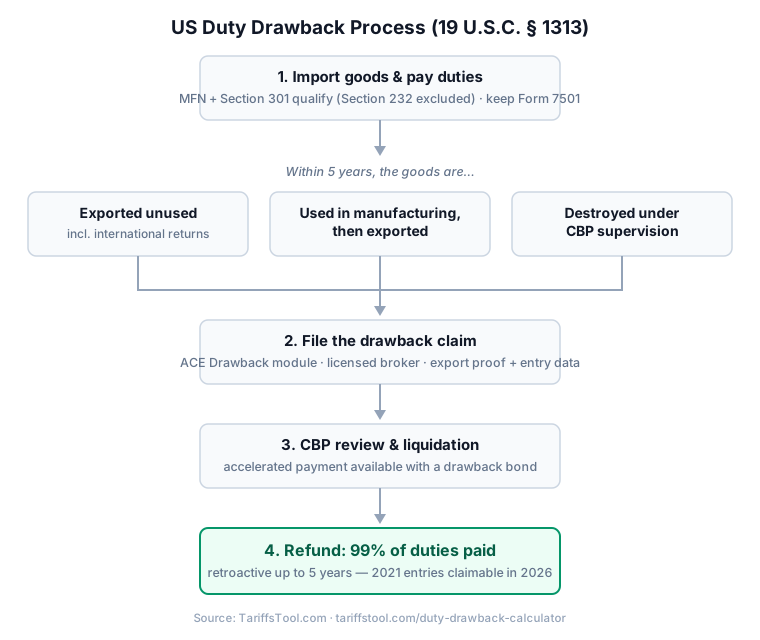
Duty drawback recovers up to 99% of US Customs duties on imports that are exported, destroyed, or used in manufactured exports. The process involves seven discrete steps spanning anywhere from 6 to 24 months from the original import to the refund payment. Here's the flow chart in plain English — each step, the forms involved, the typical timing, and the things that trip up first-time filers.
The Process at a Glance
Seven steps:
- Import the goods, pay duty.
- Document the entry (Form 7501).
- Export, destroy, or manufacture-and-export the goods.
- Document the export (Bill of Lading, AES filing) or destruction (CBP-supervised).
- Prepare the drawback claim (Form 7551) through ACE Drawback.
- CBP reviews the claim.
- Refund issued via ACH.
Deadline: drawback claims must be filed within 5 years of the original import entry date. Miss the window and the claim is denied.
This chart is the permanent drawback program under 19 U.S.C. § 1313. It is not CAPE and it is not an IEEPA refund. The full eligibility guide is duty drawback. A rough annual figure, from your own volumes, is the duty drawback calculator — illustrative, not a promised recovery.
Step 1: Import and Pay Duty
The drawback clock starts when goods clear US Customs and the duty is paid. Your customs broker files the entry summary (Form 7501) and pays duty via ACH on your behalf.
For drawback purposes, what matters is the entry number, entered value, HTS classification, and duty paid. All four must be precisely documentable later. This is why broker-managed import data is so important — manual record-keeping inevitably loses fields needed for the drawback claim three years later.
Advertisement
Step 2: Document the Original Entry
Pull and store the Form 7501 entry summary immediately. Keep your broker invoice, the duty payment confirmation, the commercial invoice from the supplier, the Bill of Lading, and any HTS classification rulings.
For manufacturing drawback, also document the receipt of the imported goods into your facility — production logs, inventory transfers, BOM (bill of materials) entries linking imported components to specific finished goods.
Document decay is the #1 reason drawback claims fail. Records you can pull in month one are often unrecoverable in year four.
Step 3: Export, Destroy, or Manufacture-and-Export
The qualifying event has to happen within 5 years of the original entry date. Three paths:
Direct export (1313(j)(1) unused merchandise drawback): imported goods are exported in essentially the same condition. Easiest documentation.
Destruction (1313(j)): imported goods are destroyed under CBP supervision. CBP must witness or formally authorize the destruction; informal disposal does not qualify.
Manufacturing and export (1313(a) or 1313(b)): imported components are used in manufactured goods that are subsequently exported. Documentation must trace each imported unit through production to a specific export.
Step 4: Document the Export or Destruction
For exports: capture the Bill of Lading, the export commercial invoice, the AES (Automated Export System) filing confirmation, and proof of payment from the foreign buyer. The export must be documentable as actually leaving the United States.
For destructions: capture the CBP Form 28 or equivalent destruction supervision documentation. CBP either witnesses the destruction or authorizes a third-party-supervised destruction with specific paperwork.
Both: the export or destruction must occur within 5 years of the original entry.
Step 5: Prepare the Drawback Claim
Your licensed customs broker prepares the claim on CBP Form 7551 (the drawback entry) using the ACE Drawback module.
The claim package includes: the import entry data (entry numbers, HTS, duty paid), the export or destruction documentation, the substitution rationale (if applicable), and the calculation of refund amount.
First-time filers should also file a drawback ruling request with CBP to confirm eligibility and apply for accelerated payment privilege if recovery volume justifies it.
Step 6: CBP Review
CBP reviews the claim against import data already in ACE, the export/destruction documentation, and the chain-of-custody narrative.
Clean claims with full documentation typically clear in 6-12 months. Claims with documentation gaps go to manual review and can take 12-24 months. Claims with substantive issues — incorrect HTS, weak substitution rationale, missing export proof — may be denied entirely or require multiple rounds of supplemental documentation.
This is where broker experience matters most. Brokers who file drawback regularly know which patterns CBP examines closely and which claim types accelerate cleanly.
Step 7: Refund via ACH
Approved drawback claims pay via ACH directly to the importer's enrolled bank account. CBP does not issue paper drawback checks.
With accelerated payment privilege, partial payment can issue before final liquidation; standard claims pay after the full review cycle completes.
For recurring drawback programs, accelerated payment privilege is essential — it converts drawback from a 12-18 month receivable into a 30-60 day cash flow item.
Common Mistakes
Five mistakes that tank claims:
- Missing the 5-year filing deadline — file claims well before the deadline, not at the last minute.
- Incomplete export documentation — ensure your AES filings and Bills of Lading match your drawback claim line by line.
- HTS mismatch — the import HTS and the drawback claim HTS must reconcile (substitution claims have specific commercial-interchangeability rules).
- Inventory-tracking gaps for manufacturing drawback — the chain from imported component to exported finished good must be auditable.
- Self-filing without broker expertise — drawback is documentation-intensive and unforgiving. First-time filers almost always benefit from broker support.
Key Takeaway
Duty drawback is a seven-step process: import, document, export or destroy, document the export/destruction, prepare the claim through ACE Drawback, CBP review, ACH payment. The 5-year deadline starts on the import entry date. Documentation rigor at the import stage and the export stage determines whether the claim clears in 6 months or stalls in manual review. For recurring drawback volume, work with a licensed customs broker who files drawback regularly and apply for accelerated payment privilege early. See /duty-drawback-services for filing help.
Calculate Your Import Duty
Get an instant estimate for your specific product, country, and shipment value.
Open the US Import Duty CalculatorAdvertisement