
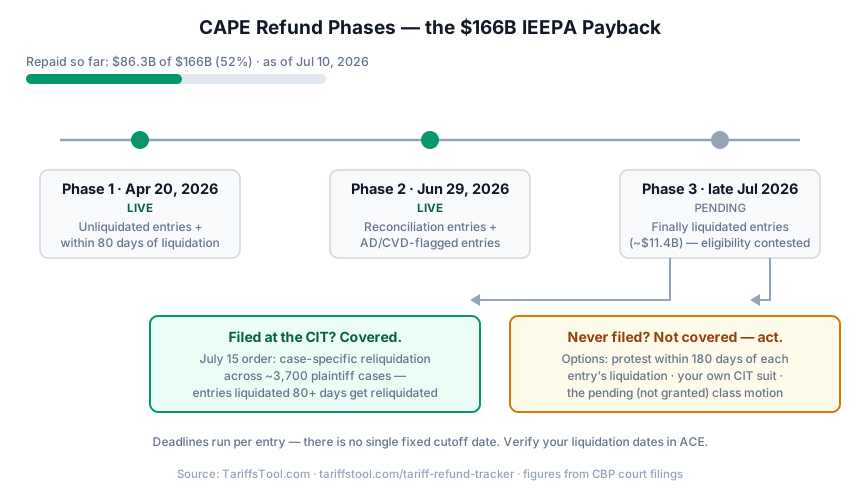
Phase 3 update, Sept 15: CBP told the Court of International Trade Phase 3 (finally-liquidated entries) will deploy October 6, 2026, limited to importers who are CIT plaintiffs and submitted their IOR number by July 30, 2026. Phase 1 and Phase 2 continue processing normally. Full CAPE Phase 3 guide →
On April 20, 2026, US Customs and Border Protection launched Phase 1 of the Customs Adjustment for Phased Entry (CAPE) portal inside the ACE system. Twenty-two days later, on May 12, the first ACH refunds hit importer bank accounts. But Phase 1 is narrower than most filers realize. It covers two specific buckets of IEEPA entries — unliquidated entries and entries within 80 days of liquidation. Phase 2 went live June 29, 2026, adding reconciliation and AD/CVD entries. Phase 3, for finally-liquidated entries and originally expected in late July, was pushed back — CBP told the CIT on August 25, 2026 it delayed deployment to add validations, and a September 15, 2026 CBP declaration confirmed the new launch date of October 6, 2026, limited to CIT plaintiffs who submitted their IOR number by July 30, 2026. Note that drawback claims, surety-paid, TIB and warehouse entries are not covered by these phases. This guide walks through exactly what CAPE is, which entries qualify for Phase 1, what Phase 2 added, where Phase 3 stands today, how to check entry status inside ACE, and the most common reasons claims are getting rejected right now. For live dollar totals across all three phases, see our [CAPE refund status tracker](/cape-refund-status).
What CAPE Is
CAPE — the Customs Adjustment for Phased Entry portal — is the refund mechanism CBP built to comply with the March 4, 2026 Court of International Trade order directing the agency to refund all 330,000+ importers who paid IEEPA tariffs between April 2025 and February 23, 2026. The order followed the Supreme Court's February 20, 2026 ruling in *Learning Resources v. Trump* (6-3), which struck down the IEEPA tariff regime as unconstitutional.
In dollar terms, the order covers roughly $166 billion across 53 million-plus entries. That is the largest customs refund event in US history.
CBP couldn't process that volume through the normal protest channel (CBP Form 19), so CAPE was built as a streamlined refund track inside the existing ACE Portal. It launched as Phase 1 on April 20, 2026, and Phase 2 went live June 29, 2026, extending coverage to reconciliation and AD/CVD entries (with a Phase 3 for finally-liquidated entries expected in late July, for CIT filers only). Refunds are paid via ACH to the bank account enrolled in the importer's ACE account, with statutory interest running from the date the original duty was paid.
Phase 1 Eligibility: The 80-Day Rule
Phase 1 covers exactly two categories of IEEPA entries:
1. Unliquidated entries. Any entry that has not yet liquidated is eligible. Most US customs entries liquidate automatically by operation of law 314 days after the entry summary date — about ten and a half months. Entries filed in mid-2025 onward are still unliquidated and almost always Phase 1 eligible.
2. Liquidated entries within the 80-day rule. Entries that have already liquidated are eligible only if liquidation occurred within 80 days of the date the CAPE Declaration is submitted. Past 80 days, the entry falls outside Phase 1 and rolls to Phase 2 (or to the formal protest process).
The 80-day window isn't arbitrary. It mirrors the 180-day formal protest window in 19 U.S.C. § 1514 but tightens it inside CAPE so CBP can pull entry records cleanly without contesting later corrections. Practically, the rule means importers need to file CAPE Declarations promptly after entries liquidate — particularly older 2025 entries that are liquidating on rolling dates throughout the second half of 2026.
Phase 1 also requires:
- Active ACE Portal account with the importer's IOR number
- ACH banking enrolled in the Importer sub-account before submission (most common rejection cause)
- Entry data that matches what CBP has on file (HTS, value, quantity, country of origin)
- IEEPA duty actually paid on the entry (entries that only carried Section 232/301 are not eligible)
Refunds are paid 60-90 days after CAPE accepts the Declaration, plus statutory interest. First payments hit May 12, 2026.
Advertisement
What's Excluded From Phase 1
If your entries fall into any of these buckets, you cannot collect through Phase 1 today:
- Reconciliation entries filed under 19 U.S.C. § 1484b — these are flagged by CBP and held for Phase 2.
- Drawback claims filed against IEEPA-duty entries — drawback runs through a separate ACE module and is not part of CAPE.
- Entries liquidated more than 80 days before your CAPE Declaration submission — these roll to Phase 2 or require a formal CBP protest under § 1514.
- Entries under active CBP audit, investigation, or AD/CVD review — these are pulled from CAPE until the underlying matter resolves.
- Entries with unresolved data discrepancies — HTS mismatches, value variances, or COO discrepancies between your records and CBP's trigger the "Unable to calculate duty" error and have to be reconciled before resubmission.
For importers carrying meaningful exposure in any excluded category, the right move today is to document the entries, preserve all records, and prepare the Phase 2 filing package so it's ready when the second tranche opens.
Free Refund Estimate
See your country-specific IEEPA refund in 60 seconds. Full breakdown emailed in 5 minutes.
Phase 2: Now Live (Opened June 29, 2026)
Phase 2 opened June 29, 2026 and is live in the ACE Portal. Its scope:
- Reconciliation entries (types 01/02/06, flagged for a not-yet-filed type 09) — still limited to unliquidated entries or those within 80 days of liquidation.
- Entries with AD/CVD overlays.
Phase 2 is estimated to add roughly 2.8 million entries and ~$28.7 billion, bringing combined Phase 1+2 coverage to about $130 billion of the $166 billion pool.
What Phase 2 does NOT cover: finally-liquidated entries move to Phase 3 — expected late July 2026, and only for importers who filed at the Court of International Trade (CIT). Drawback claims, surety-paid entries, TIB entries, and warehouse withdrawals are not part of these phases and mostly need a separate track (drawback runs through its own ACE module; older liquidated entries may require a formal § 1514 protest).
The practical effect for importers: if your entries are reconciliation or AD/CVD, the channel is open now — file promptly. If you paid IEEPA duties on entries that finally liquidated in summer/fall 2025, watch for Phase 3 (CIT filers) or preserve rights through a protest.
Phase 3: Launches October 6, 2026, for CIT Plaintiffs Only (Updated September 2026)
Phase 3 is meant to cover finally-liquidated entries — roughly $11.4 billion of the $166 billion pool — and was originally expected in late July 2026. In an August 25, 2026 update to the Court of International Trade, CBP said it had temporarily delayed Phase 3 deployment to build additional validations ensuring reliquidation doesn't inadvertently alter non-IEEPA duties (Section 232/301) assessed on the same entries. A September 15, 2026 CBP declaration to the CIT confirmed Phase 3 will deploy October 6, 2026 — but only for importers of record who are plaintiffs in a pending CIT case and who submitted their IOR number to CBP by July 30, 2026.
Phase 1 and Phase 2 are unaffected and continue processing normally — the restriction is specific to finally-liquidated entries. Separately, a Federal Circuit appeal over the CIT's underlying reliquidation order remains pending (DOJ's opening brief was filed August 10, 2026); that appeal, not the October 6 launch, will determine whether non-litigant importers with finally-liquidated entries can be paid administratively at all, or need to sue individually. For the full mechanics and what to do if your entries are finally liquidated, see our dedicated Phase 3 guide.
How to Check Entry Status in ACE
Inside the ACE Portal, the report that tells you Phase 1 eligibility is the REV-615 Entry Summary Status Report, available under Reports → Account Revenue. Run it for the IOR number across the period April 2025 - February 2026.
The column that matters is Liquidation Status:
- "Unliquidated" — Phase 1 eligible today.
- "Liquidated" with a date within 80 days of today — Phase 1 eligible, but the window is closing daily; file the CAPE Declaration as soon as possible.
- "Liquidated" with a date more than 80 days ago — outside Phase 1; document for Phase 2 or a formal protest.
- "Suspended" — held for reconciliation, AD/CVD, or audit; held for Phase 2.
The second status to check is the REV-310 Liquidation Calendar, which projects when unliquidated 2025 entries are expected to liquidate. Most 2025 IEEPA entries will hit liquidation by late summer 2026, so the 80-day window will be closing on rolling dates from mid-July onward. Filing CAPE Declarations before liquidation is operationally simpler than racing the 80-day clock after.
Common Phase 1 Rejection Causes
CBP's first 90 days of CAPE submissions show four dominant rejection patterns, accounting for roughly 79% of all rejections:
1. HTS classification mismatches — the HTS code on the CAPE Declaration doesn't match the HTS on the original entry. Most common when broker rebilling or post-entry amendments shifted the classification. Triggers "Unable to calculate duty" or "Classification mismatch" errors.
2. Valuation inconsistencies — declared value on the CAPE Declaration differs from CBP's record by more than a small tolerance. Common when reconciliation or supplemental declarations changed value after entry. Triggers "Value variance exceeds threshold."
3. Country-of-origin discrepancies — COO on the Declaration doesn't match CBP's record. Most common with transshipped goods or goods where origin was reclassified after entry under § 304 substantial transformation rules.
4. Section 232/301 stacking errors — entries where Section 232 or 301 duties were paid in addition to IEEPA and the CAPE Declaration tries to claim refund on the wrong layer. Section 232/301 are not refundable through CAPE; only the IEEPA layer is.
For importers with $250,000+ in expected refund, the right move is a pre-filing data audit that reconciles your records against CBP's REV-615 export *before* you submit the Declaration. Resubmissions are allowed but each cycle adds 30-60 days to the refund timeline.
Estimate Your Refund First
Before filing, importers should know roughly what's at stake — the difference between filing a clean Declaration and resubmitting after rejection can be 60-90 days of float on the refund. A 60-second estimator returns a country-specific refund estimate (based on the pre-ruling IEEPA rate and your import volume) and emails the full breakdown within 5 minutes. No commitment, no broker engagement required at the estimate stage — it's a sizing exercise to decide whether to file CAPE in-house or engage professional support. Refunds over $100,000 typically warrant a pre-filing audit; refunds under that threshold are often filed by the importer's existing customs broker without outside help.
Key Takeaway
CAPE Phase 1 launched April 20, 2026 and started paying refunds May 12, 2026. The phase covers two categories: unliquidated IEEPA entries and IEEPA entries within 80 days of liquidation. Phase 2 went live June 29, 2026, adding reconciliation and AD/CVD entries. Phase 3, covering finally-liquidated entries, was delayed by CBP on August 25, 2026 and now launches October 6, 2026 for CIT plaintiffs only — Phase 1 and Phase 2 keep processing normally in the meantime. Drawback claims, surety-paid, TIB and warehouse entries are not covered by these phases. Inside ACE, the REV-615 report shows eligibility and the REV-310 liquidation calendar projects when 2025 entries will hit the 80-day clock. The dominant Phase 1 rejection patterns are HTS classification mismatches, valuation inconsistencies, country-of-origin discrepancies, and Section 232/301 stacking errors. For importers carrying $250K+ in expected refund, a pre-filing data audit cuts the resubmission cycle materially. For the rest, the operational play is straightforward: confirm ACE access, enroll ACH banking, run the REV-615, and file the CAPE Declaration before the 80-day window closes on 2025 entries.
Free · 60 Seconds · No Commitment
Estimate your IEEPA refund before you file.
Country-specific refund estimate based on the pre-ruling IEEPA rate and your import volume. Full breakdown emailed in 5 minutes.
Estimate My Refund →Advertisement