
Have finally liquidated 2025 entries and never filed at the CIT? Our licensed trade-attorney partners review your ACE data, identify which entries are still protestable, and handle protective filings where exposure justifies it. Get a finally-liquidated entry review →
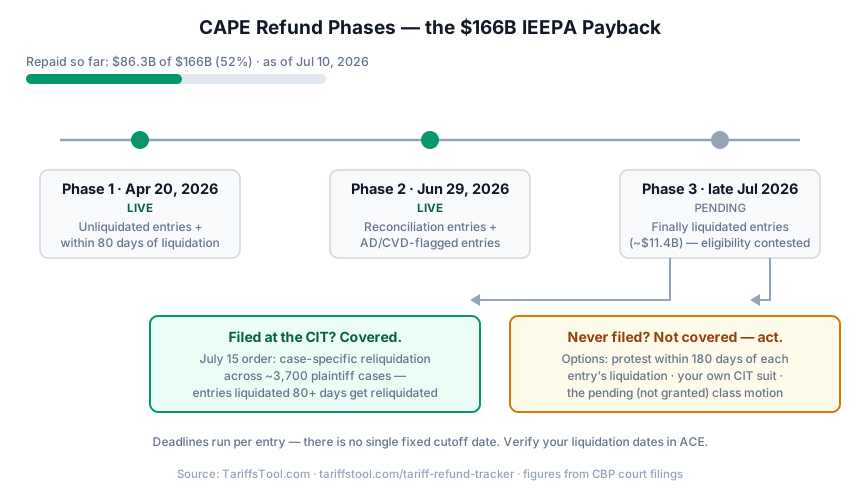
The single most contested question of the $166 billion IEEPA refund — who gets paid on finally liquidated entries — just got its clearest answer yet. On July 15, 2026, the Court of International Trade signaled it will issue case-specific orders across roughly 3,700 individual IEEPA cases, each directing CBP to reliquidate the plaintiffs' entries that liquidated more than 80 days ago, stripped of the unlawful IEEPA duties. That is the government's plaintiffs-only reading of CAPE Phase 3 implemented in concrete form: importers who filed a protective action at the CIT now have a court-ordered path to their money. Importers who never filed are not covered by these orders — their claims ride on the government's pending Federal Circuit appeal, a class-certification motion that has not been granted, or the per-entry administrative windows still open to them. This guide sorts you into the right lane and tells you what to do in each.
What the July 15 Order Actually Does
Until now, the finally-liquidated fight lived at the level of principle: the CIT ordered universal refunds; the government appealed, arguing CBP lacks authority to reopen final liquidations for anyone who didn't sue.
The July 15 development moves to mechanics. The court signaled it will issue case-specific reliquidation orders in roughly 3,700 individual IEEPA cases. Each order directs CBP to reliquidate — without the IEEPA duties — the entries of the plaintiffs in that case that liquidated more than 80 days ago (the entries CAPE Phases 1 and 2 could not reach).
Two things follow. First, CIT plaintiffs now have a concrete, per-case mechanism for Phase 3 payment rather than a general promise. Second, the orders' case-by-case structure is itself confirmation of the eligibility line the government has drawn: relief is being administered plaintiff by plaintiff, not universally.
Covered: You (or Your Counsel) Filed at the CIT
If your company is a named plaintiff in one of the ~3,700 cases, your finally liquidated entries are headed for court-ordered reliquidation.
What to do now:
- Confirm your case and entry list with counsel. The orders are case-specific — make sure every finally liquidated entry you own is actually attached to your case.
- Reconcile your ACE data. Reliquidation happens entry by entry; entries missing from your complaint's scope may need separate treatment.
- Expect statutory interest. Refunds carry interest under 19 U.S.C. 580 / 24.36 rates — for many 2025 entries that is a meaningful addition.
- Watch timing, not eligibility. Your question is now when, not whether. CBP told the court it will have Phase 3 processing capability in late July.
Advertisement
Not Covered: Your Three Remaining Paths
If you never filed at the CIT, the July 15 order does nothing for you directly. Your finally liquidated entries still hold refund value — CBP is holding duties the Supreme Court ruled unlawful — but reaching it requires one of three paths:
- A protest, if your window is still open. Under 19 U.S.C. 1514 you can protest a liquidation within 180 days of the liquidation date, entry by entry. A timely protest preserves the claim no matter how the Federal Circuit appeal resolves. Entries liquidated in early 2026 have windows closing through this summer — pull your liquidation dates in ACE and check each one.
- Your own CIT action. The one path the government concedes. For importers with six- or seven-figure finally liquidated exposure, a protective filing is the insurance policy that does not depend on anyone else's appeal or class motion.
- The pending class action. A class-certification motion covering non-filing importers is pending. If granted, it could sweep in importers who never sued — but it has not been granted, and waiting on it is a bet, not a plan.
The honest framing: none of these paths has a fixed calendar cliff — protest windows run per entry, and the two-year statute for court actions runs per entry as well. But per-entry clocks expire continuously. Every week, some importer's oldest entries quietly age out.
The Math on Waiting vs. Acting
For a concrete decision, weigh three numbers:
- Your finally liquidated exposure. Sum the IEEPA duties on entries that liquidated 80+ days ago. That is the amount this fight is about for you — for many mid-size importers it is the largest single line of their refund.
- The cost of a protective filing. Trade counsel file protective CIT actions at fixed or contingency cost that is small relative to six-figure exposure.
- The downside of waiting. If the Federal Circuit sides with the government and the class motion fails, non-filers whose protest windows lapsed recover nothing on those entries. That is the scenario a protective filing removes.
Importers with small finally liquidated exposure can rationally ride the appeal and class motion. Importers with material exposure and open windows are paying for optionality they are not using.
Key Takeaway
The July 15 CIT order converts CAPE Phase 3 from a contested promise into a queue — and confirms who is in it: the roughly 3,700 cases' plaintiffs, entry by entry. If that is you, reconcile your entries and watch for your case's order. If it is not, your claims survive only as long as your per-entry windows do. A licensed trade attorney can tell you in one conversation which of your entries are covered, protestable, or in need of a protective filing — and our partner bench does exactly that.
Calculate Your Import Duty
Get an instant estimate for your specific product, country, and shipment value.
Open the US Import Duty CalculatorAdvertisement